Ir al contenido principal

Autor: Marta Villasán

Interview with José Carlos Sires

José Carlos Sires is a Sevillian naturalist who has overcome the loss of vision at the age of six to become an expert in bioacoustics. Initially known for his extraordinary ability to identify the Iberian birds by their songs, Sires has recently expanded his expertise into the fascinating world of orthopterans.

We will explore José Carlos Sires’ journey into the world of orthopteran bioacoustics, his field experiences, the challenges he faces, and how his work is contributing to our understanding of these fascinating insects.

Sires’ transition from ornithology to orthopteran bioacoustics not only reflects his versatility as a naturalist but also highlights the importance of sound in studying and conserving biodiversity. His unique experience offers valuable insights into how we perceive and understand the natural world through hearing, especially in the relatively unexplored field of singing insects.

His involvement in the TEOSS (Training for the European Orthoptera Sound System) project marks a significant milestone in his career, taking him to explore the Sierra de La Demanda in Spain. There, alongside other specialists, Sires has contributed to the study and recording of sounds produced by crickets, grasshoppers, and locusts, demonstrating that his keen auditory sense transcends the realm of birds.

Inicios y motivación

How did you move from your initial interest in birds to bioacoustics in general?

Actually, recording nature sounds, when you want to record specific species, is a bit lonely because people tend to get in your way, willingly or unwillingly. It is difficult to record in company. What happens? I have to do it because I can’t go to the field alone, so I started to record by audio-trapping, that is, I was trying to record specific species of birds, but to avoid my companion having to wait there for a while quiet and still, I used the audio-trapping technique, where I saw that there could be an influx of birds or that the species I was interested in could be, so my companion put the recorder and we came to pick it up after a while.

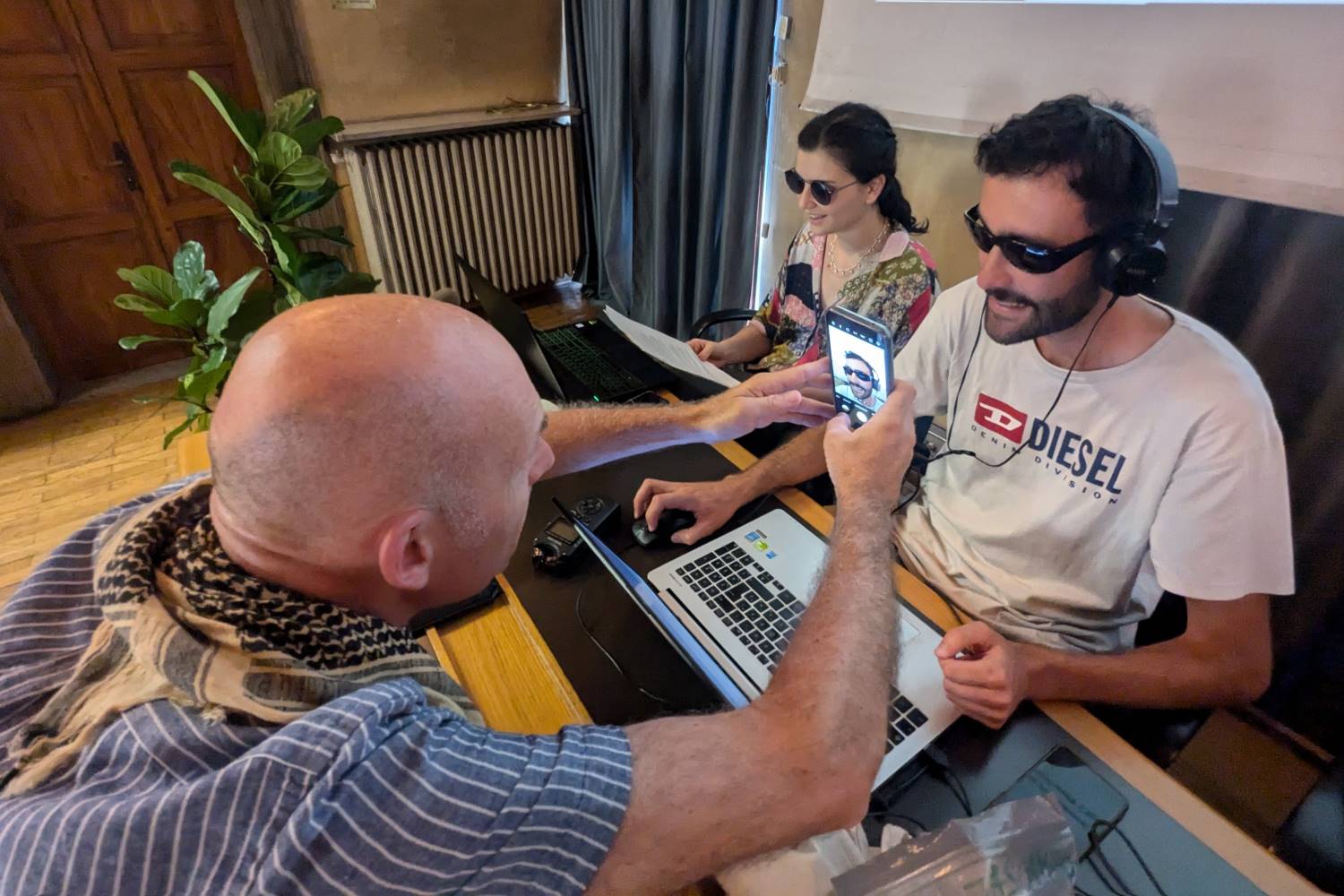
 Workshop de La Demanda, Agosto de 2024.

What happened?

Well, things started to happen to me, like maybe I didn’t catch the species I was looking for or I didn’t catch any birds nearby, because what I did with those recordings was to select the birds that could be heard closest, individually, and there were times when I didn’t catch any birds nearby, but the whole thing started to seem beautiful to me and I started to like it aesthetically. And that’s when I started to become interested in what soundscapes as a whole would be, in what bioacoustics is, what soundscapes are, soundscapes as elements of biodiversity.

What attracted you to the sounds of nature other than birds?

My original interest was in birds, and because of the way I recorded I ended up becoming interested in soundscapes, but mainly based on birds. But other things always crept in. Both when I was recording individual birds and when I was recording soundscapes, amphibians and insects crept in… and I started to like it. I started to get interested in those other faunal groups that crept in and made the landscape richer and more beautiful. And why did I become interested in the world of Orthoptera? Because there were some soundscapes here in certain areas that had a number of rather curious species of Orthoptera, and I became curious to know what they were… That fascination of saying, oysters, what different species of Orthoptera are singing at the same time as the scops owl? How cool! And from there I started to want to know what each one was and what variety of bugs there were in the area where I was filming.

Transition to Orthoptera bioacoustics

How did your interest in the sounds of Orthoptera arise?

Well, I think that’s answered in the second question, but let’s see, my interest in other faunal groups began to emerge because, let’s say, they crept into my recordings of birds and among them, orthoptera crept into my recordings, didn’t they? And then, of course, he wants to know, he wants to name them. You hear a lot of different species singing and you say, ‘Wow, what are they! And from there, that’s where that interest came from.

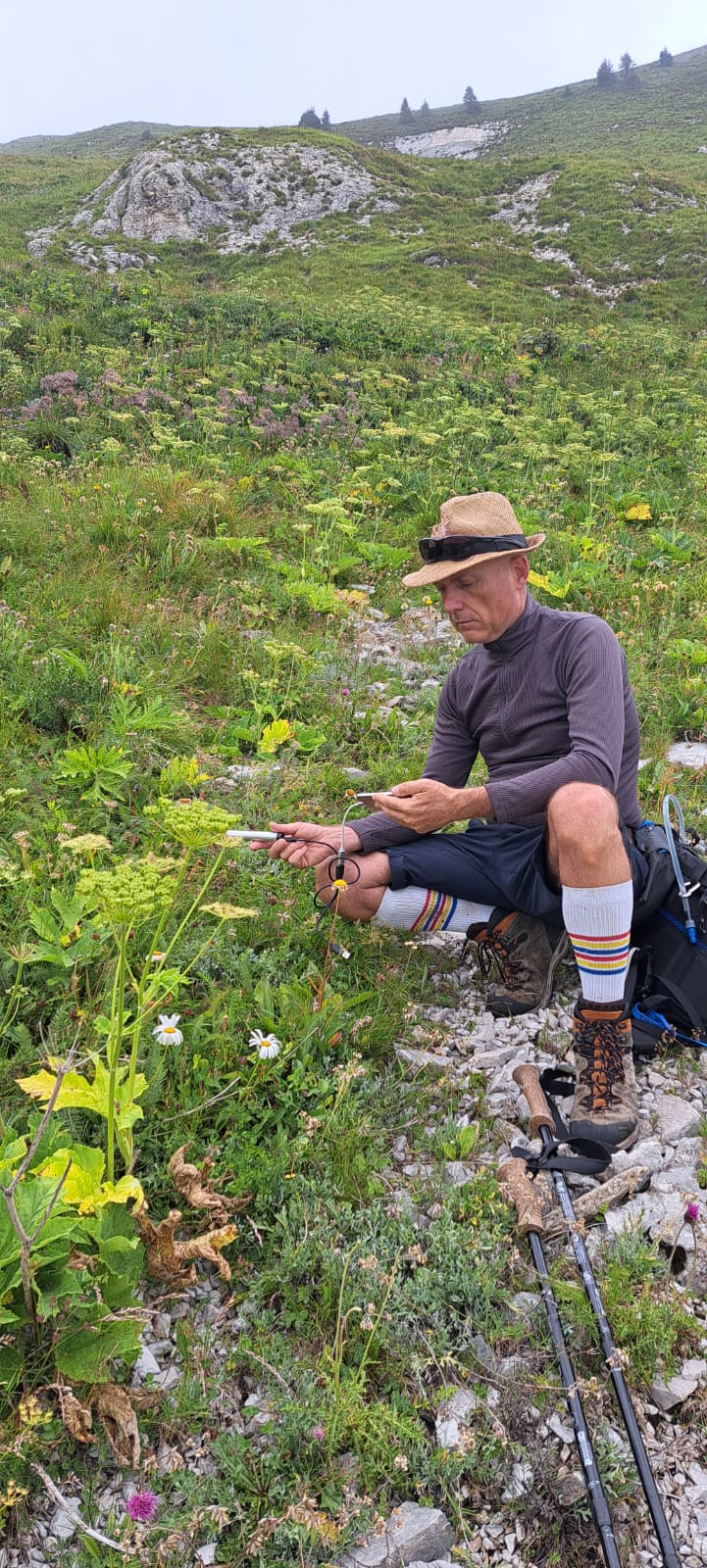
Pycnogaster escondido entre el brezo. La Demanda, Agosto de 2024.

What differences and similarities do you find between identifying birds and Orthoptera by their sounds?

Well, the similarities are that each species, both in birds and in Orthoptera, has a – let’s say – song, some distinctive calls, and you can use those different calls to identify each species. The difference is that in birds it’s easier to do that by ear, although not always, but in birds it’s easier with just your ear. In Orthoptera it is often necessary to use ultrasound devices, sonograms, sometimes it is even impossible to differentiate the species by song and you have to use other methods to decide which species it is. The identification of Orthoptera is more complex in general terms.

Techniques and methodology

What methods do you use to record and analyse Orthoptera sounds?

Last summer I started slightly, but before participating in the TEOSS workshop on orthopteran bioacoustics I did not have, I think, the necessary knowledge to even start recording. So I consider that I am just starting a little bit now. Technically speaking, I have several recorders: a Tascam DR-05T, which is very flimsy in its casing, but it records very well; an Olympus DM 770, which I don’t usually use for this, it records quite well, but not as well as the Tascam. And I also have a Songmeter 2.0, and the story of that recorder is very nice, because when the pandemic started, to help people get through it a bit and I was more entertained too, I made a group of bird sounds and so on, and together they collected money and gave me a parabolic microphone and that recorder. What happens is that I don’t use it very much because, although it’s a professional recorder for capturing soundscapes, it’s very big, it’s like half a shoebox. So I don’t usually use it. For the moment, what I’ve recorded is mainly with the Tascam DR-05 in WAV and just by hand. I also have the parabolic mic, which I intend to use to record insects that I can’t reach so easily, for example because there is a bush in the way, a fence, etcetera. Parabolas for bass sounds sometimes cause problems, but for treble sounds they work very well and you can record this type of animal without any problem. For ultrasounds I would have to use devices that lower the frequency to make it audible to humans, because I am not able to see it reflected in sonograms. That is also what happens, that for the recording of Orthoptera and the processing of the audios you have to use sonograms for the differentiation of species and that is something that escapes me a little bit.
Compartiendo la escucha con la siguiente generación.

Then I process the recordings with Audacity, which is adapted so that it can be used by blind people. I do a very slight processing, I cut the lowest frequencies, which is impossible for the insect to step on, and that’s it. In other words, if I cut it from 500 Hertz down, it won’t catch what an insect sings. And nothing, that’s how I do it, but I haven’t started yet. I made some small studio recordings of Pterolepis cordubensis, but I didn’t do them well because they were recorded in Fauna Box and it generated some very strange echoes and things, but in the TEOSS workshop last year I learned how to make this kind of recordings at home and this year I’m going to make as many recordings in insect fields and those that sound like that, more subdued and so on, I’ll make them studio recordings, in their little tea ball, making a little house of cushions as we learned last year.

How have you adapted your auditory identification techniques to this new group of insects?

Well, although I have some audio guides, I would like to get hold of some more, but I feel that I lack knowledge, I lack a lot of knowledge. Here in Cordoba there is a great orthopterologist, Ginés, who I hope we can make a good symbiosis.

I can distinguish the songs that can be differentiated by ear in an obvious way, but the ones you have to use a sonogram, I would need external help. But let’s say, the ones that can be heard by ear, well, it’s simply a matter of either using a sound guide and learning to differentiate them, or they can tell me this is this one and I can learn it. It’s like birds in that sense. It is more difficult because there are more species, they are less studied, in fact there are many whose songs are not yet known or there are fewer sound guides, but in short, more difficult. But by ear you can identify many of them or make a rough identification and then specify it by other methods.

Projects and collaborations

Tell us about your participation in the TEOSS project

My participation in the Teos project is not yet very extensive because I am just starting with Orthoptera and last summer I could not dedicate myself to it as much as I would have liked. But I do want to participate, especially because I live in an area in the south of the Iberian Peninsula that is very rich in Orthoptera.
José Carlos Sires.

There are some species whose songs are not even recorded or there are very few recordings and I would like to help even if only to enrich the collections; if I can discover the song of a species that is not yet recorded I would like to try to do so either in the studio or in the field. Above all I would like to provide recordings for the databases, with the help of an orthopterist.

What has your experience been like collaborating with other researchers in this field?

It’s been limited, but it’s been fun. The people I’ve been lucky enough to come across have been good people. They have offered to help me with whatever I need and I have done the same. They’ve also seen me as useful and that’s appreciated. We’ve had some great days at the orthopteran recording workshops. I have met quite a few people, quite a few researchers and I see that in general people are willing to help, collaborate and make symbiosis and questions of this kind. I hope that this year I will be able to do more things. In fact, just the other day this orthopterologist Ginés told me that in Cordoba there were few Svercus palmatorum found, and I hear it in many places. But there is no one here who is paying attention to these things, nor anyone who is sampling or anything else. And yet, the other day I found a new locality for the species.

Then, I try to help the species that are not very well recorded or for which there are no recordings, to try to enrich with their help, because I need more help to go out into the field, to catch the bugs, etcetera, due to my circumstances. My experience has been limited, but good.

Challenges and achievements

What are the main challenges you have faced when working with Orthoptera bioacoustics?

Well, my situation is simply a challenge for this for several reasons. First of all, I cannot go into the field by myself and capture the orthoptera and so on. For that I need help. And secondly, to analyse sonograms and so on, so in that sense I’m a bit limited, but people appreciate me for my hearing, my interest in recording and so on. They tend to lend me out, but of course it’s more difficult. I can’t go out on my own whenever I want in the field, I can’t do certain things, and that’s the main challenge, because of my disability.
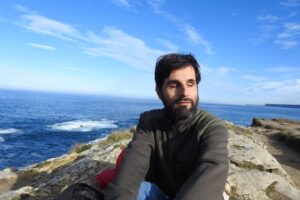
José Carlos Sires.

What do you consider to be your greatest achievement or discovery in this field so far?

My greatest achievement was very nice and it was almost by chance and it was at the beginning of my interest in Orthoptera. When I became interested, there is a species that has a very particular song, which is the Eugryllodes pipiens. Well, back in 2017 my partner told me that he was going to take me to a place in the mountains of Cordoba that he liked a lot. When we arrived, it was getting dark and that species, the Eugryllodes pipiens, has a very beautiful song and I heard it and I said ‘Wow, how beautiful! When I mentioned it to an entomology enthusiast here in the province of Cordoba, he said that there were no records of this species here. He said: ‘Hey, take me to the site and we’ll capture some specimens to determine the species, to see if it’s exactly Eugryllodes pipiens or if it’s something similar. I didn’t know, but there was another similar one, Eugryllodes escalerae, which I don’t know about the sonogram, but the song, to the human ear, is either the same or very similar. I would have to listen to many recordings and have a lot of experience with both abundant species, so I might be able to tell them apart.

When we went there, my partner, another researcher and I, the two of them with the torch, catching the crickets, which are super small, and they caught some and the determination was made and it was finally determined that they were E. escalerae. I helped to make this discovery of a species that apparently had not been recorded in Córdoba, and I don’t think it had been recorded in Andalusia either, or at least in western Andalusia.

Importance of bioacoustics

How does bioacoustics contribute to the conservation of Orthoptera and biodiversity in general?

I think bioacoustics is a good method to detect unseen species. Both the species and the density in the area and the variety. A soundscape is like an auditory photograph of the biodiversity in that area, the biodiversity of the species that vocalise or emit a sound. You play a tape recorder or listen at night in a certain place and you can find out how many orthopterans there are, both the number and the species. In fact, it is becoming clear that we are heading towards a so-called silent spring. Soundscapes in which there are fewer and fewer species, fewer and fewer individuals of each species, and so on. And this can be detected with bioacoustics. Then there is the fact that it has been scientifically proven that listening to nature sounds is beneficial to health. So this can also be used for conservation, encouraging people to conserve a rich biodiversity. Because then, if we expose ourselves to the sounds of that rich biodiversity, we get a health benefit and a sensory and aesthetic pleasure.
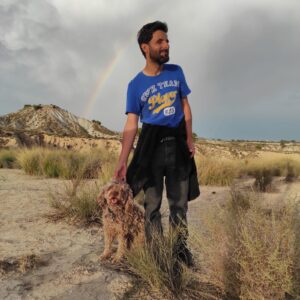
José Carlos Sires.

What role does citizen science play in your research on Orthoptera?

The role that citizen science plays in orthopteran identification is important. Mainly because you have an impressive number of people out there recording and collecting sounds. This also has another aspect, and that is that some are experts, others are intermediate level and others don’t know anything. This introduces a margin of error that needs to be filtered out, but I think that citizen science, if well managed, can be very beneficial in orthopterology. It is even possible to make discoveries about distributions, species distribution, etcetera. At www.xenocanto.org people can upload their recordings and the collection is getting richer and richer with all kinds of fauna sounds.

Divulgación y educación

How do you adapt your workshops and talks to include information on Orthoptera?

At the moment my workshops are mostly about birds. But yes, if I listen to one when we do a bird identification walk, I talk a little bit about their importance, both as consumers of small animals, grass, etcetera, and as a large and very important base of the food chain for other animals. If I can identify the species I explain a bit, tell what species it is, how they make their sounds, and so on. But I haven’t done specific workshops for this yet.

It’s more about taking the opportunity when I do bird workshops, if I come across any orthopteran sounds, I talk about them as much as I can and I usually give the information in the most attractive and interesting way possible. And how it all comes together. Because if you are giving a bird workshop, orthoptera are an important food source for many species, if there is a good population of orthoptera there will be a good population of birds.
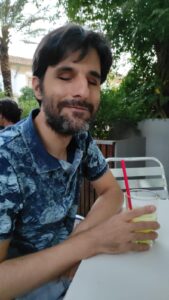
José Carlos Sires.

Future of research

What areas of Orthoptera bioacoustics would you like to explore in the future?

Precisely for me one of the biggest attractions of this is to record species that have not yet been recorded or that have not been recorded much and help to build distribution maps of species such as Svercus palmatorum, for me it is a common species but the distribution map in Cordoba is not well detailed: it is supposed to be scarce but I have heard it in many localities… What is there in places where no one goes, where no one lives? I think that my main attraction for this is that here everything is still to be done because, although I really want to record capercaillie or skylark, there are already recordings of these species. It is true that there are areas of the world where there are bird species that have not yet been recorded. But here the birds are practically all already recorded, everything is quite detailed, there is always something more that can be learned, but everything is already done.

However, in Orthoptera everything is still to be done and that is the biggest attraction for me. There I can do real science, I can discover something, I can record something important… And with birds that’s difficult, for me recording birds is something more personal, more of my own desire. But with Orthoptera I can still do science and I can discover interesting things and that’s what motivates me: above all I would like to enrich the collections of recordings, because what I like is to record, above all.

José Carlos y Elvia la Rastreadora.

What advice would you give to other researchers interested in this field?

My advice to those who want to do research in Orthoptera bioacoustics is simply to do it, because everything here is still to be done and that is very stimulating. They should be patient and start anywhere because I believe that there can be something new anywhere. Here in Spain we are in a very rich place and you can find a new species anywhere, a species that is not yet mentioned in the distribution, that the map is not well defined, and so on. If they want to do research on this, let them do it, because there is still a lot to do. In other faunal groups you have to get into more specific things, but in Orthoptera they haven’t even started yet.

Personal experiences

How has your experience with bioacoustics influenced your general perception of the natural world?

Since I am blind, it is my way of perceiving the natural world. But I think that with sight you see a beautiful or ugly landscape, but you see the landscape. But with hearing you see a bit more of everything at the same time, both the landscape and the biodiversity. Because you can detect the species; the air, depending on the temperature, transmits sound differently, so you can often even tell if the landscape is recorded at dawn or at dusk. And depending on the place, the sonorities are different. In other words, in a soundscape you can perceive the global whole and, of course, the richness of the biodiversity there. And then there is the aesthetic element. Sighted people like to see a natural landscape or a beautiful animal, and I like to see a rich and varied soundscape. It’s simply that. It’s my way of perceiving the natural environment.


Funded by the European Union. Views and opinions expressed are however those of the author(s) only and do not necessarily reflect those of the European Union or REA. Neither the European Union nor REA can be held responsible for them.

Entrevista con José Carlos Sires

José Carlos Sires es un naturalista sevillano que ha superado la pérdida de visión a los 6 años para convertirse en un experto en bioacústica. Inicialmente conocido por su extraordinaria habilidad para identificar la avifauna ibérica por sus cantos, Sires ha ampliado recientemente su experiencia al fascinante mundo de los ortópteros.

En esta entrevista

Exploraremos el viaje de José Carlos en el mundo de la bioacústica de ortópteros, sus experiencias en el campo, los desafíos que enfrenta, y cómo su trabajo está contribuyendo a nuestro entendimiento de estos fascinantes insectos.

Recorrido de Sires

Inicios y motivación

¿Cómo pasó de su interés inicial por las aves a la bioacústica en general?

En realidad, la grabación de sonidos de la naturaleza, cuando quieres grabar especies concretas, es algo un poco solitario porque la gente tiende a estorbarte, queriendo o sin querer. Es difícil grabar en compañía. ¿Qué ocurre? Que yo tengo que hacerlo porque yo al campo solo no puedo ir, por lo cual pues empecé a grabar mediante audiotrampeo, es decir, yo intentaba en principio grabar especies concretas de aves, pero para evitar que mi acompañante tuviera que esperar ahí un rato callado y quieto, pues tiré un poco de la técnica del audiotrampeo, donde veía que podía haber una afluencia de aves o que pudiera estar la especie que me interesaba, pues mi acompañante me colocaba la grabadora y veníamos a recogerla al rato. 

Workshop de La Demanda, Agosto de 2024.

¿Qué pasó?

Pues que empezaron a ocurrirme cosas como que a lo mejor no pillaba la especie que pretendía o no pillaba ningún pájaro cerca, porque yo lo que hacía luego con esas grabaciones era seleccionar los pájaros que se oían más cerca, así a modo individual, y había veces que no pillaba cerca ningún pájaro, pero todo el conjunto pues empezó a parecerme bonito y empezó a agradarme estéticamente. Y fue ahí cuando empecé a interesarme por lo que sería el conjunto de los paisajes sonoros, por lo que es la bioacústica, lo que son eso, los paisajes sonoros como elementos de biodiversidad.

¿Qué le atrajo de los sonidos de la naturaleza más allá de las aves?

Mi interés primigenio fueron las aves y por mi forma de grabar acabé interesándome en los paisajes sonoros pero basado en aves principalmente. Pero siempre se me acababan colando otras cosillas. Tanto cuando grababa aves en individual como cuando grababa paisajes sonoros, se me colaban anfibios, insectos… y empezó a gustarme la cosa. Empecé a interesarme también por esos otros grupos faunísticos que se me colaban y que hacían el paisaje más rico y más bonito. Y cuanta más especies sonaban, más me gustaba. ¿Y por qué empecé a interesarme por el mundo de los ortópteros? Porque había aquí en ciertas zonas unos paisajes sonoros que tenían una cantidad de especies de ortópteros bastante curiosas y ya empezó a picarme la curiosidad de saber lo que eran… Esa fascinación de decir, ostras, ¿Qué de especies diferentes de ortópteros están cantando a la vez que el autillo? ¡Qué chulo! Y ya de ahí empecé a querer saber qué era cada uno y qué variedad de bichos había en esa zona donde yo estaba grabando.

Transición a la bioacústica de ortópteros

¿Cómo surgió su interés por los sonidos de los ortópteros?

Pues creo que está respondida en la segunda, pero vamos, pues mi interés en otros grupos faunísticos empezó a surgir porque, digamos, se me colaban en las grabaciones de aves y entre ellos pues se me colaban ortópteros, ¿no? Y ya pues claro, pues él quiere saber, él quiere ponerle nombre. Escuchas que están cantando un montón de especies distintas y dices, ¡ostras, cuáles son! Y de ahí, pues de ahí surgió ese interés. 


Pycnogaster escondido entre el brezo. La Demanda, Agosto de 2024.

¿Qué diferencias y similitudes encuentra entre la identificación de aves y ortópteros por sus sonidos?

Pues las similitudes es que pues cada especie, tanto en aves como en ortópteros, pues tiene una -digamos- canción, unas llamadas distintivas y tú puedes utilizar esas llamadas diferentes para identificar cada especie. La diferencia estriba en que en las aves es más fácil hacer eso a puro oído, si bien no siempre, pero en las aves es más fácil con simplemente tu oído. En ortópteros muchas veces hay que tirar de aparatos que captan ultrasonido, de sonogramas, a veces incluso es imposible diferenciar la especie por el canto y tienes que tirar de otros métodos para decidir qué especie es. Es más compleja la identificación de ortópteros en líneas generales.

Técnicas y metodología

¿Qué métodos utiliza para grabar y analizar los sonidos de ortópteros?

El verano pasado me inicié ligeramente, pero antes de participar en el taller de iniciación en bioacústica de ortópteros de TEOSS no tenía, creo, los conocimientos necesarios para siquiera empezar a grabar. Entonces considero que estoy empezando un poco ahora. En cuanto a la técnica, tengo varias grabadoras: una Tascam DR-05T, que en la carcasa es muy endeble, pero graba estupendamente; unas Olympus DM 770, que no las suelo usar para esto, graban bastante bien, pero no tanto como la Tascam. Y tengo también una Songmeter 2.0, que además la historia de esa grabadora es muy bonita, porque cuando empezó la pandemia, para ayudar a que la gente pasara un poco el trago y estuviera más entretenido yo también, pues hice un grupo de sonidos de aves y tal, y entre todos hicieron una colecta y me regalaron un micro parabólico y esa grabadora. Esa, lo que pasa es que la uso muy poco porque, aunque es una grabadora profesional para la captación de paisaje sonoro, es muy grande, es como media caja de zapatos. Entonces no la suelo usar. De momento lo que he grabado sobre todo es con la Tascam DR-05 en WAV y así a pelo, con la mano. Tengo también el micro parabólico, que lo pienso usar para grabar insectos a los cuales no pueda llegar tan fácilmente, por ejemplo porque haya un zarzal por medio, una valla, etcétera. Las parábolas para sonidos graves a veces dan problemas, pero para agudos funcionan muy bien y se puede grabar con ellas este tipo de animales sin problema. Sí que para los ultrasonidos tendría que tirar de los aparatos que lo que hacen es bajar la frecuencia para hacerla audible al ser humano, porque reflejada en sonogramas yo no soy capaz de verlo. Eso también es lo que pasa, que para la grabación de ortópteros y procesados de los audios hay que tirar un poco de sonogramas para la diferenciación de especies y eso pues a mí pues se me escapa un poquito.

Compartiendo la escucha con la siguiente generación.

Luego las grabaciones las proceso con Audacity, que está adaptado a que se pueda manejar por invidentes. Le hago un procesado muy leve, le corto las frecuencias más bajas, que es imposible que ahí pise con el insecto y ya está. O sea, si le corto de 500 hercios para abajo no va a pillar lo que canta un insecto. Y nada, así es como lo hago, pero es que todavía no he empezado. Hice unas pequeñas grabaciones en estudio de Pterolepis cordubensis, pero no las hice bien porque estaban grabadas en Fauna Box y generaba unos ecos y unas cosas muy raras, pero en el taller de TEOSS del año pasado ya aprendí cómo hacer este tipo de grabaciones en casa y este año pues voy a hacer tantas grabaciones en campos de insectos y los que suenen así, más tenue y tal, pues lo haré grabación en estudio, en su bolita de té, haciendo una casita de cojines como aprendimos el año pasado.

¿Cómo ha adaptado sus técnicas de identificación auditiva a este nuevo grupo de insectos?

Pues aunque tengo alguna guía sonora, me gustaría hacerme con alguna más, pero siento que me faltan conocimientos, me faltan muchos conocimientos. Aquí en Córdoba hay un gran ortopterólogo que es Ginés, que espero que podamos hacer una buena simbiosis. 

Yo los cantos que se pueden diferenciar a oído de forma obvia, sí puedo, pero las que hay que tirar de sonograma, pues necesitaría una ayuda externa. Pero vamos, las que se sacan a oído, pues simplemente es o tirar de guía sonora y aprender a diferenciarla o que me vayan diciendo esta es esta y ya yo me lo aprendo. Es como las aves en ese sentido. Más difícil porque son más especies, está menos estudiado, de hecho hay muchas que todavía los cantos no se conocen o hay menos guías sonoras, pero en fin, más difícil. Pero a oído se pueden identificar muchas o hacer una identificación somera y luego especificarla mediante otros métodos.


Proyectos y colaboraciones

Háblenos sobre su participación en el proyecto TEOSS

Mi participación en el proyecto Teos todavía no es muy amplia porque, estoy empezando con los ortópteros y el verano pasado al final no pude dedicarme a ello como me habría gustado. Pero sí quiero participar sobre todo porque vivo en una zona en el sur de la península ibérica que es muy rica en ortópteros.

José Carlos Sires.

Hay algunas especies cuyos cantos ni siquiera están captados o hay muy pocas grabaciones y me gustaría ayudar aunque fuera simplemente a enriquecer las colecciones; si puedo descubrir el canto de alguna especie que no esté grabada aún me gustaría intentarlo ya sea en estudio o en campo. Sobre todo quiero proveer de grabaciones a las bases de datos, ayudado por algún ortopterólogo.

¿Cómo ha sido su experiencia colaborando con otros investigadores en este campo?

Es escasa, pero ha sido divertida. La gente con la que he tenido la suerte de toparme ha sido buena gente. Se han ofrecido a ayudarme en lo que necesite y yo lo mismo. Me han visto también útil y eso se agradece. Hemos hecho algunas jornadas chulas en los talleres de grabación de ortópteros. He conocido a bastante gente, a bastantes investigadores y veo que en general la gente se presta a ayudar, colaborar y hacer simbiosis y cuestiones de este tipo. Espero que este año pueda hacer más cosillas. De hecho, simplemente el otro día me comentaba este ortopterólogo Ginés que en Córdoba había pocos Svercus palmatorum localizados, y yo lo escucho en muchos sitios. Pero es que aquí no hay nadie que esté pendiente de estas cosas ni nadie que esté haciendo muestreos ni nada. Y sin embargo, el otro día di con una nueva localidad para la especie.

Luego, intentar ayudar a las especies que están poco grabadas o de las que no existen grabaciones, intentar enriquecer con su ayuda, porque yo necesito por mis circunstancias más ayuda para salir al campo, para pillar los bichos, etcétera. Mi experiencia ha sido escasa, pero buena.

Desafíos y logros

¿Cuáles son los principales retos que ha enfrentado al trabajar con bioacústica de ortópteros?

Pues simplemente mi situación es un desafío para esto por varios motivos. En primer lugar, yo no puedo desplazarme solo al campo y capturar los ortópteros, etcétera. Para eso necesito ayuda. Y en segundo lugar, pues para analizar sonogramas, etcétera, de modo que en ese sentido estoy un poco limitado, pero la gente me estima por mi oído, por mi interés en grabar, etcétera. Se me suelen prestar, pero claro que es más difícil. Yo no puedo salir por mí mismo siempre que quiera al campo, no puedo hacer ciertas cosas y ese es el principal desafío, pues mi discapacidad.

José Carlos Sires.

¿Cuál considera que ha sido su mayor logro o descubrimiento en este campo hasta ahora?

Mi mayor logro fue muy bonito y fue casi por casualidad y fue al principio de yo estar interesado por los ortópteros. Cuando me empecé a interesar hay una especie que tiene un canto muy particular que es el Eugryllodes pipiens. Bueno, pues mi pareja allá por 2017 me dijo que me iba a llevar a un sitio de la sierra de Córdoba que le gustaba mucho. Cuando llegamos, estaba anocheciendo y esa especie, el Eugryllodes pipiens, tiene un canto muy bonito y lo escuché y digo ¡Ostras, qué guapo!. Cuando se lo comenté a un aficionado a la entomología de aquí de la provincia de Córdoba y dijo que aquí no había citas de esa especie. Me dijo: Oye, llévame al sitio y vamos a capturar algunos ejemplares para determinar la especie, a ver si es exactamente Eugryllodes pipiens o es alguna parecida. Yo no lo sabía pero había otra parecida que es Eugryllodes escalerae, que no sé en sonograma pero el canto, a oído humano, es o igual o muy parecida. Tendría que escuchar muchas grabaciones y mucha experiencia con ambas especies abundantes, igual así sí las diferencio. 

Cuando fuimos allí, mi pareja, otro investigador y yo, ellos dos con la linterna, pillando los grillos, que son súper pequeños y cogieron algunos y se hizo la determinación y se determinó que finalmente eran E. escalerae. Ayudé a hacer ese descubrimiento de una especie que parece ser que no estaba citada en Córdoba, y creo que en Andalucía tampoco lo estaba, o al menos en Andalucía occidental. 

Importancia de la bioacústica

¿Cómo contribuye la bioacústica a la conservación de los ortópteros y la biodiversidad en general?

Creo que la bioacústica es un buen método para detectar especies que no se ven. Tanto la especie como la densidad que pueda haber en la zona y la variedad. Un paisaje sonoro es como una fotografía auditiva de la biodiversidad que hay en esa zona, la biodiversidad de las especies que vocalizan o emiten algún sonido. Tú pones una grabadora o escuchas por la noche en un determinado sitio y puedes saber la cantidad de ortópteros, tanto el número como las especies que hay. De hecho, se está comprobando que nos encaminamos hacia la llamada primavera silenciosa. Unos paisajes sonoros en los que cada vez hay menos especies, menos individuos de cada especie, etc. Y eso con la bioacústica se puede detectar. Luego está el hecho de que se ha comprobado científicamente que escuchar sonidos de la naturaleza es beneficioso para la salud. De modo que esto también se puede utilizar para conservación, el hecho de estimular a la gente a conservar una biodiversidad rica. Porque luego, si nos exponemos a los sonidos de esa rica biodiversidad, obtenemos un beneficio de salud y un placer sensorial y estético. 

José Carlos Sires.

¿Qué papel juega la ciencia ciudadana en su investigación sobre ortópteros?

El papel que juega la ciencia ciudadana en la identificación de ortópteros es importante. Principalmente, porque tienes ahí una cantidad impresionante de gente grabando y recogiendo sonidos. Esto también tiene otra vertiente y es que algunos son expertos, otros nivel medio y otros no saben nada. Eso introduce un margen de error que hay que depurar, pero creo que la ciencia ciudadana, si se gestiona bien, puede ser muy beneficiosa en la ortopterología. Incluso seguro que se pueden hacer descubrimientos de distribuciones, de distribución de especies, etcétera. En www.xenocanto.org la gente puede volcar sus grabaciones y la colección cada vez se va enriqueciendo más con todo tipo de sonidos de fauna.

Divulgación y educación

¿Cómo adapta sus talleres y charlas para incluir información sobre ortópteros?

De momento mis talleres son sobre todo de aves. Pero sí, si escucho alguno cuando hacemos paseo de identificación de aves, hablo un poquito de su importancia, tanto como consumidores de pequeños animalitos, de hierba, etcétera, como ser una gran y muy importante base de cadena alimenticia para otros animales. Si puedo identificar la especie explico un poco, cuento qué especie es, cómo emiten sus sonidos, etcétera. Pero no he hecho todavía talleres específicos para esto. 

Es más aprovechar la oportunidad cuando hago en los talleres de aves si me cruzo algún sonido de ortóptero, hablo lo que puedo de ellos y suelo dar la información de la forma más atractiva y más interesante posible. Y cómo se entreteje todo. Porque si estás dando un taller de aves, los ortópteros para muchas especies son una fuente de alimentación importante, si hay una buena población de ortópteros va a haber una población buena de aves.

José Carlos Sires.

Futuro de la investigación

¿Qué áreas de la bioacústica de ortópteros le gustaría explorar en el futuro?

Precisamente para mí uno de los mayores atractivos de esto es grabar especies que aún no estén grabadas o que lo estén poco y ayudar a construir mapas de distribución de especies como pasa con Svercus palmatorum, para mí es una especie común pero el mapa de distribución en Córdoba no está bien detallado: se supone que es escaso pero yo lo he escuchado en muchas localidades… ¿Qué no habrá en sitios donde no va nadie, donde no vive nadie? Creo que mi mayor atractivo para esto es que aquí está todo por hacer porque, aunque tengo muchas ganas de grabar urogallo o alondra ricotí, de estas especies hay ya grabaciones. Sí que es verdad que hay zonas del mundo donde hay especies de aves que todavía están poco grabadas. Pero aquí las aves prácticamente están todas ya grabadas, está todo bastante detallado, siempre hay algo más que se puede aprender pero está todo bastante hecho. 

Sin embargo, en Ortópteros está todo por hacer y ese es el mayor atractivo para mí. Ahí puedo hacer ciencia de verdad, puedo descubrir algo, puedo grabar algo importante… Y en las aves ya eso es difícil, para mí grabar aves es algo más personal, más de mi propio deseo. Pero con los Ortópteros todavía puedo hacer ciencia y puedo descubrir cosas interesantes y eso es lo que me motiva: sobre todo me gustaría enriquecer las colecciones de grabaciones, porque a mí lo que me gusta es grabar, sobre todo.

¿Qué consejo daría a otros investigadores interesados en este campo?

Mi consejo a los que quieran investigar en bioacústica de ortópteros simplemente es que lo hagan, porque aquí está todo por hacer aún y eso es muy estimulante. Que tengan paciencia y que empiecen por cualquier sitio porque creo que en cualquier sitio puede haber algo nuevo. Aquí en España estamos en un sitio muy rico y se puede sacar de cualquier lado una especie nueva, una especie que no aún no esté citada en la distribución, que no esté bien definido el mapa, etcétera. Si quieren investigar de esto, que lo hagan porque queda mucho por hacer aún. En otros grupos faunísticos te tienes que meter en cosas más específicas pero en ortópteros es que no están ni empezados.

Experiencias personales

¿Cómo ha influido su experiencia con la bioacústica en su percepción general del mundo natural?

Puesto que soy invidente, es mi forma de percibir el mundo natural. Pero pienso que por la vista tú ves un paisaje bonito o feo, pero ves el paisaje. Pero con el oído ves un poco más todo a la vez, tanto el paisaje como la biodiversidad. Porque puedes detectar las especies; el aire, según esté a una temperatura u otra, transmite el sonido de forma diferente, por lo que incluso muchas veces puedes saber si el paisaje está grabado al amanecer o al anochecer. Y según el lugar, las sonoridades son distintas. O sea, en un paisaje sonoro puedes percibir el todo global y, por supuesto, la riqueza de la biodiversidad que hay allí. Y luego el elemento estético. A las personas que tienen visión les gusta ver un paisaje natural o un animal bonito y a mí un paisaje sonoro rico y variado. Simplemente eso. Es mi forma de percibir el medio natural.


Funded by the European Union. Views and opinions expressed are however those of the author(s) only and do not necessarily reflect those of the European Union or REA. Neither the European Union nor REA can be held responsible for them.

Entrevista con Filippo Buzzeti

Filippo Maria Buzzetti es un destacado investigador italiano especializado en la bioacústica de ortópteros. Como miembro de la Fundación Museo Cívico de Rovereto, Buzzetti ha desempeñado un papel fundamental en el avance del conocimiento sobre la producción sonora en estos fascinantes insectos.

En esta entrevista

… exploraremos la trayectoria de Filippo Buzzetti en el fascinante mundo de la bioacústica de ortópteros, sus contribuciones al campo, y cómo su trabajo está ampliando nuestra comprensión de la comunicación acústica en estos insectos.

Recorrido de Buzzeti

Introducción a la bioacústica

¿Cómo te interesaste por primera vez en la bioacústica de los ortópteros?

Me interesé en la bioacústica de los ortópteros mientras trabajaba en mi tesis de grado, que se centraba en las especies de ortópteros de las montañas cercanas a mi hogar. Mi tutor sugirió incorporar la bioacústica al estudio. Fue entonces cuando me di cuenta de que podía recolectar más que especímenes físicos: podía grabar y analizar los cantos de las especies, añadiendo una nueva dimensión a mi investigación.

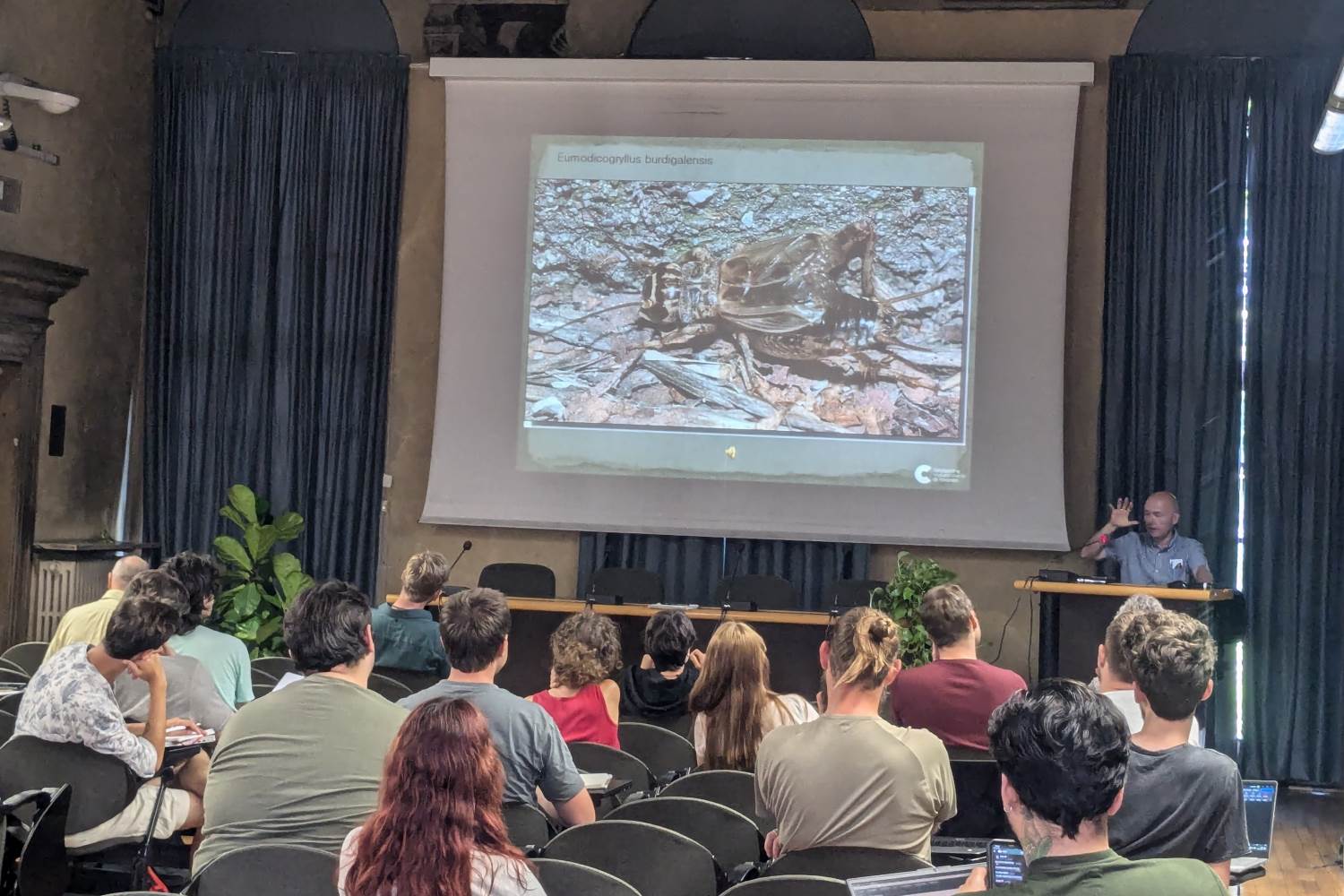
Workshop de Verona, Julio de 2024.

¿Cuál es la importancia de la bioacústica en el estudio y la conservación de estos insectos?

La bioacústica juega un papel crucial para comprender la vida en el planeta, proporcionando mucha más información que los cuerpos recolectados o las fotografías. Representa algo vivo que puede revelar la salud de la fauna y del entorno en su totalidad. Cuando estamos en la naturaleza y escuchamos muchos sonidos naturales, esto indica un ambiente saludable. En cambio, en las áreas urbanas, los sonidos dominantes suelen ser antropogénicos, lo cual refleja un entorno con poca salud natural.

¿Qué metodologías y técnicas podemos utilizar?

Existen muchas formas de grabar los sonidos de los ortópteros. Cualquier persona con una tableta, teléfono móvil o micrófono digital puede lograr excelentes resultados. Además, los micrófonos ultrasónicos USB son herramientas ideales para capturar sonidos de alta frecuencia de manera efectiva.

Proyectos y colaboraciones

Háblanos de tu participación en el proyecto TEOSS

Participé en el proyecto desde el principio gracias a Florent. Es una iniciativa muy interesante que captó mi atención de inmediato. Florent tiene ideas claras y bien definidas sobre los objetivos del proyecto, que busca llegar a una audiencia lo más amplia posible. Esto es especialmente valioso, ya que la mayoría de los capacitadores tienden a enfocarse en audiencias muy específicas. Estoy contento de ser parte de este esfuerzo.

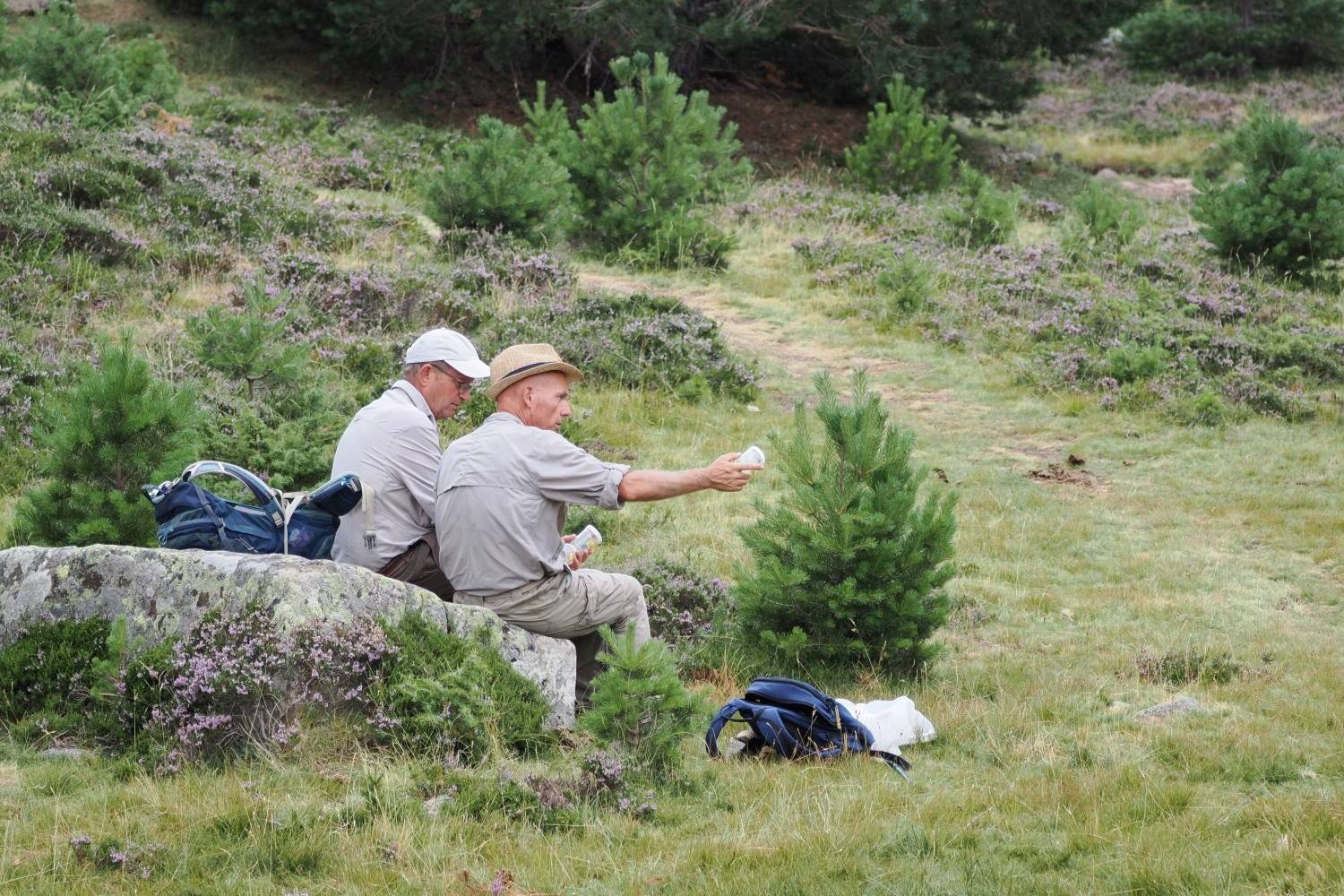
Workshop de La Demanda, Agosto de 2024.

Organicé el primer encuentro en Italia, con actividades en el museo, recorridos por las colinas para grabar sonidos de ortópteros y enseñanzas en el Museo de Historia Natural de Verona. La experiencia en España también fue muy enriquecedora, aunque no soy experto en la fauna española. Sin embargo, pude recolectar una variedad de sonidos y entrenar mi oído para compararlos con los que conozco en Italia. Esto fue fascinante, ya que encontré muchos sonidos que no coincidían con grabaciones existentes, haciendo el trabajo aún más emocionante e instructivo. Ahora, estoy esperando con entusiasmo el próximo taller de verano del TEOSS en Grecia.

¿Cómo ha sido tu experiencia colaborando con otros investigadores en talleres internacionales?

Fue interesante en dos aspectos. Primero, fue muy útil colaborar con Florent, Marta y todo el equipo de AEAEBA. Aprendí mucho sobre cómo otros abordan su trabajo, lo que amplió mi perspectiva. Siempre que sentía dudas sobre cómo proceder, escuchar sus puntos de vista me ofrecía enfoques alternativos muy enriquecedores.

En segundo lugar, aprendí mucho de expertos como Baudewijn, Luc y Julien Barataud. El intercambio de conocimientos y perspectivas con otros investigadores fue emocionante y muy gratificante. Este intercambio fue un subproducto importante de la actividad y añadió un valor significativo a la experiencia.

Desafíos y avances

¿Cuáles son los principales desafíos al grabar y analizar sonidos de ortópteros?

Cuando grabas los sonidos de grillos o saltamontes, capturas un ruido o canto que es fácil de escuchar. Sin embargo, describir lo que escuchas de manera consistente y compartible es mucho más desafiante. Necesitas escribir una descripción detallada y crear ilustraciones para comunicar tus observaciones de manera efectiva. Esto es esencial para publicarlas en un artículo y que otros puedan entender lo que has documentado. Traducir lo que escuchas en palabras y figuras es un proceso complejo pero necesario.

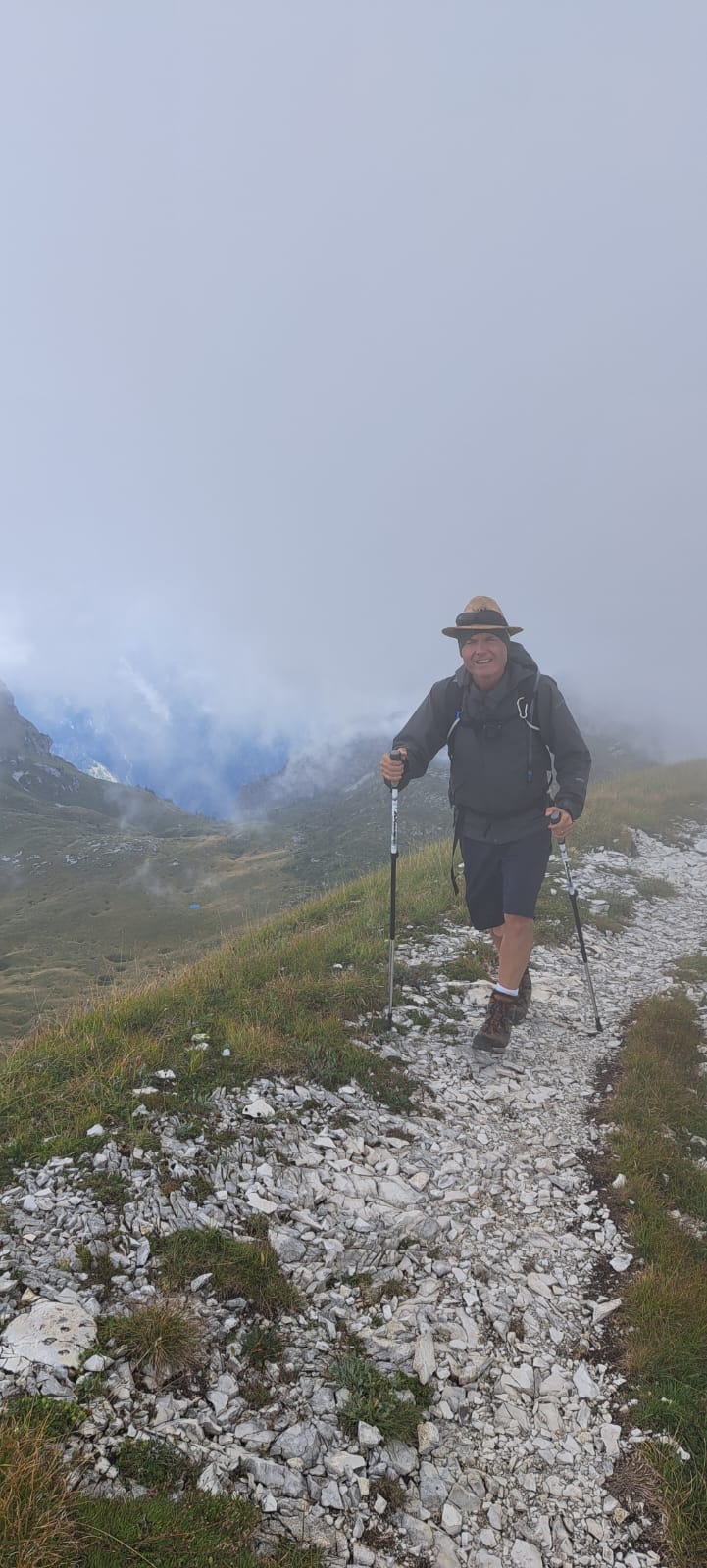
Caminando en Los Alpes par estudiar ortópteros en el campo.

Uno de los principales avances tecnológicos es que ya no necesitas un grabador especializado, ya que cualquier computadora, tableta o teléfono inteligente puede cumplir esa función. Además, los micrófonos se han vuelto mucho más asequibles y efectivos en comparación con antes. Muchas empresas están produciendo micrófonos y mejorando continuamente la tecnología para que estos equipos sean más eficientes y económicos. Por ejemplo, en 1998, un grabador promedio y un micrófono costaban alrededor de 2,000 €. Hoy en día, puedes comprar equipos de alta calidad por solo unos pocos cientos de euros, haciendo estas herramientas accesibles para un público mucho más amplio.

Conservación y biodiversidad

¿Cómo contribuye la bioacústica a la conservación de los ortópteros y la biodiversidad en general?

Creo que la bioacústica proporciona mucha más información de la que se puede obtener de un solo espécimen. Al estudiar la naturaleza, es crucial minimizar el impacto en los organismos observados. Esto no siempre es posible cuando se matan especímenes con fines de recolección.

Filippo y Cesare Brizio.

La bioacústica ofrece una alternativa no invasiva al capturar datos de organismos vivos, como sus cantos, sin dañarlos ni a ellos ni a su entorno. Esto es especialmente importante en el contexto actual de pérdida de biodiversidad. La técnica nos permite estudiar, monitorear y comprender mejor a las especies mientras preservamos los ecosistemas naturales que habitan.

¿Qué papel juega la ciencia ciudadana en tu investigación?

La ciencia ciudadana juega un papel pequeño en mi investigación, ya que no suelo usar plataformas diseñadas específicamente para ello. Principalmente utilizo ResearchGate porque me resulta más fácil conectar con personas que estudian temas similares, evitando las redes sociales.

No soy experto en trabajar con datos crudos de ciencia ciudadana. Uso Xeno-canto, aunque no es exactamente una plataforma típica de ciencia ciudadana. Es una plataforma más grande centrada en grabaciones de sonido, utilizada principalmente por personas que estudian sonidos. Aunque no sean profesionales académicos, muchos de los usuarios son muy hábiles y tienen un conocimiento comparable al de los profesionales del campo.

Futuro de la investigación

¿Cuáles son tus objetivos futuros en el campo de la bioacústica de ortópteros?

Mis objetivos futuros se centran en la conservación después de décadas recolectando especímenes. Quiero enfocarme en preservar especies en peligro. Recientemente completé un proyecto sobre Zeuneriana marmorata en las costas del Adriático. Ahora me concentro en los Alpes altos del Parque Nacional de los Dolomitas, en el noreste de Italia, donde seleccioné especies que, en mi opinión, requieren esfuerzos de conservación para garantizar su preservación.

Monitoreo de ortópteros en los prados de altitud de Italia.

¿Qué consejo darías a jóvenes investigadores interesados en este campo?

Mi consejo es que pasen tanto tiempo como sea posible en la naturaleza, entrenando su oído para reconocer quién está cantando. Lleva contigo una guía de identificación de ortópteros para ayudarte a relacionar lo que escuchas con las especies. Comienza identificando los grillos o saltamontes que encuentres, anotando su temporada de canto y comportamientos.

La clave es salir con tu mochila, enfocarte en identificar los sonidos y entender qué especies están cantando en qué época del año. Una vez que adquieras experiencia tanto en la identificación visual como en el reconocimiento de cantos, puedes comenzar a medir distancias de sonido.

Para convertirte realmente en un experto en la identificación de ortópteros, ya sea por su apariencia o por su canto, necesitas combinar ambos métodos. Esto te proporcionará una comprensión integral de la fauna que estás estudiando.

Experiencias personales

¿Podrías compartir una anécdota interesante o divertida de tu trabajo de campo?

Quiero compartir una experiencia de mi tiempo en España. España es un país hermoso, y tuve la oportunidad de pasar unos meses allí durante mi intercambio Erasmus. La naturaleza que encontré fue impresionante, y los nuevos sonidos eran bastante desconocidos para mí. Lo extraño fue que cada noche, cuando me iba a dormir, estos nuevos sonidos parecían resonar en mi mente. Había muchos grillos y saltamontes cerca de mi ventana, y su constante canto llenaba el aire día y noche. Sentía que estaban conmigo todo el tiempo, incluso mientras dormía. Fue una experiencia fascinante, y los sonidos de esos grillos se convirtieron en un recuerdo imborrable de mi tiempo en España.

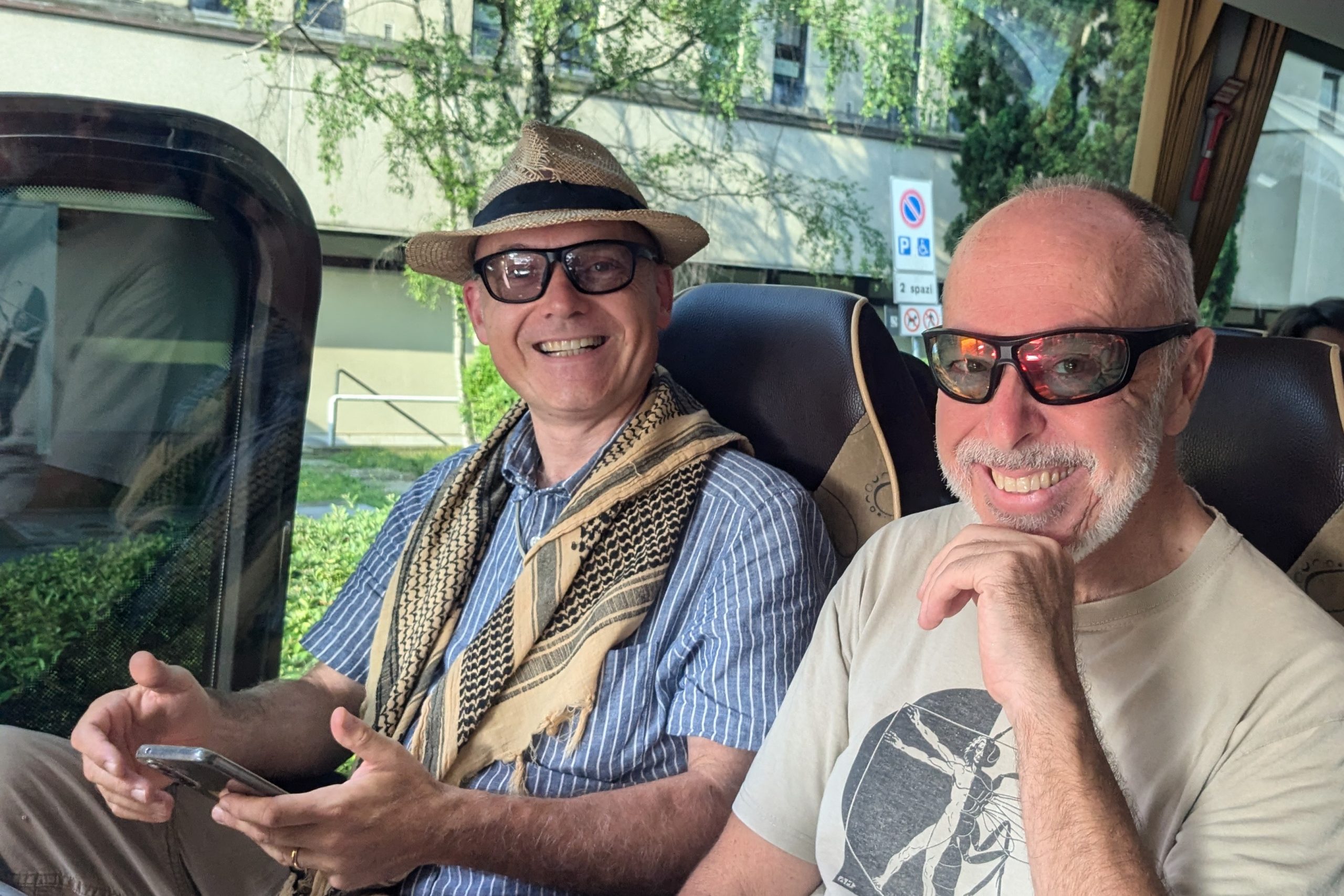
Un poc de diversión… Tiempo para los hackers en Verona.

¿Cuál ha sido tu descubrimiento más emocionante o sorprendente en tu carrera?

Uno de mis descubrimientos más emocionantes en bioacústica estuvo relacionado con un género endémico de ortópteros en los Alpes y los Apeninos, el género Anocnonotus. La oportunidad de unirme al Museo de Bozen y a la Universidad de Padua me permitió recopilar grabaciones de todas las especies de este género, lo que fue una experiencia fascinante.

Pude crear un mapa que mostraba la distribución de estas especies en los Alpes y los Apeninos, y organicé todas las grabaciones de sonido y sonogramas según sus rangos geográficos. Lo que hizo esto particularmente emocionante fue que fue la primera vez que tuve la oportunidad de escuchar el conjunto completo de grabaciones de un género en toda su área geográfica. Fue un momento único y gratificante en mi carrera.

Finalmente, espero que instituciones como la UE, así como los gobiernos nacionales y locales, reconozcan la importancia de la investigación y la necesidad de mejores conexiones entre investigadores. La colaboración y el intercambio de conocimientos son clave para la conservación de la naturaleza. Si compartimos nuestras ideas y transmitimos nuestra experiencia a las generaciones más jóvenes, además de fomentar intercambios entre expertos, podemos garantizar la continuidad de los esfuerzos de protección de la naturaleza.

Funded by the European Union. Views and opinions expressed are however those of the author(s) only and do not necessarily reflect those of the European Union or REA. Neither the European Union nor REA can be held responsible for them.

Interview with Filippo Buzzeti

[et_pb_section fb_built=»1″ _builder_version=»4.25.1″ _module_preset=»default» global_colors_info=»{}»][et_pb_row _builder_version=»4.25.1″ _module_preset=»default» global_colors_info=»{}»][et_pb_column type=»4_4″ _builder_version=»4.25.1″ _module_preset=»default» global_colors_info=»{}»][et_pb_text _builder_version=»4.25.1″ _module_preset=»default» text_font_size=»20px» text_line_height=»1.8em» text_orientation=»justified» locked=»off» global_colors_info=»{}»]

Filippo Maria Buzzetti is a prominent Italian researcher specializing in the bioacoustics of orthopterans. As a member of the Museo Civico di Rovereto Foundation, Buzzetti has played a crucial role in advancing knowledge about sound production in these fascinating insects.

[/et_pb_text][et_pb_image src="https://aeaelbosqueanimado.org/wp-content/uploads/2025/02/Filippo-Buzzeti.jpg" title_text="Filippo Buzzeti" _builder_version="4.25.1" _module_preset="default" global_colors_info="{}"][/et_pb_image][et_pb_accordion _builder_version="4.25.1" _module_preset="default" global_colors_info="{}"][et_pb_accordion_item title="In this interview" open="on" _builder_version="4.25.1" _module_preset="default" global_colors_info="{}"]

… we will explore Filippo Buzzetti’s journey into the fascinating world of orthopteran bioacoustics, his contributions to the field, and how his work is expanding our understanding of acoustic communication in these insects.

[/et_pb_accordion_item][et_pb_accordion_item title=»Buzzeti’s background» _builder_version=»4.25.1″ _module_preset=»default» global_colors_info=»{}» open=»off»]

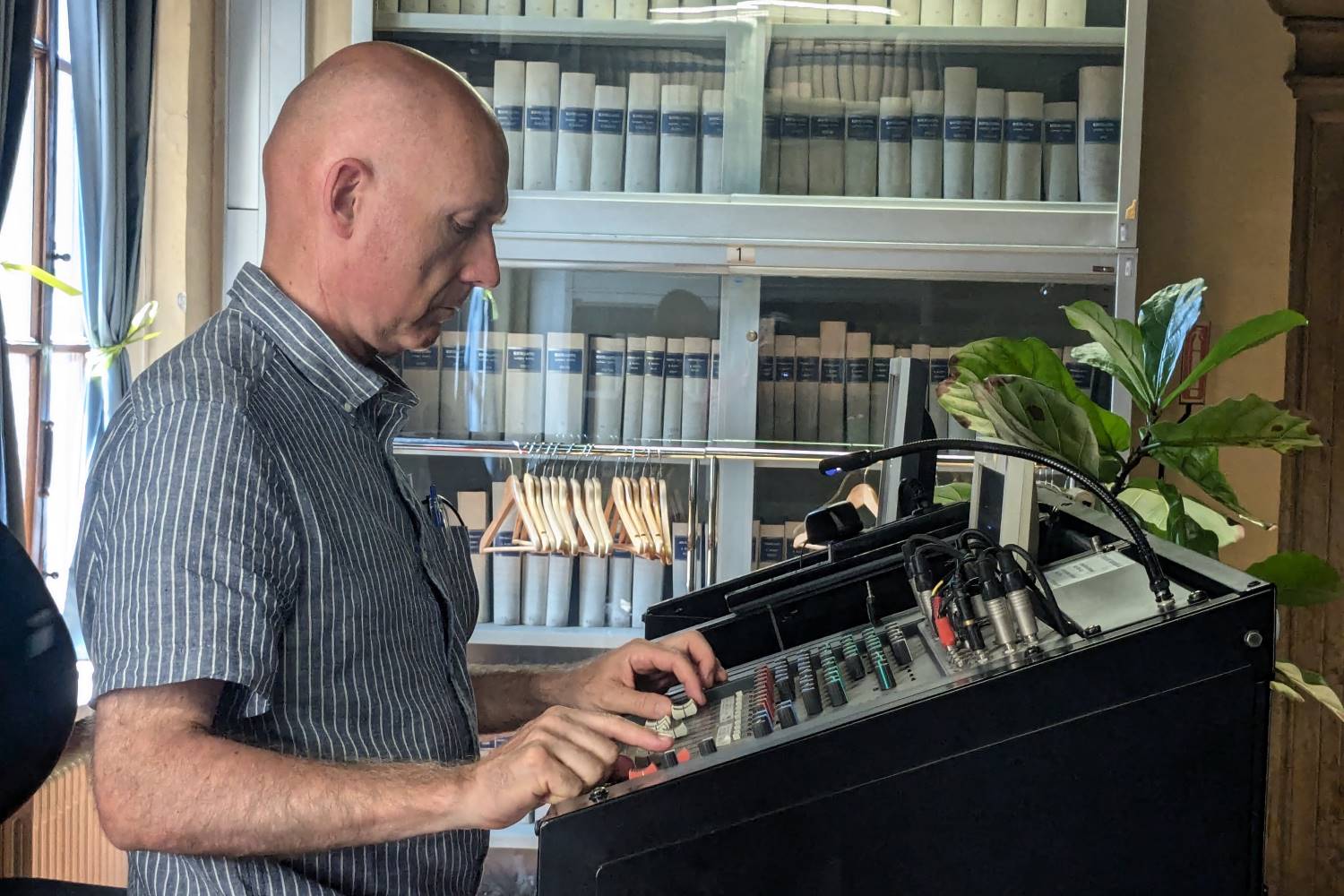
His expertise spans from comparative anatomy of sound production mechanisms in orthopterans to advanced techniques for sound recording and analysis. Buzzetti has been a key participant in the TEOSS (Training for the European Orthoptera Sound System) project, where he has shared his knowledge through lectures and international workshops.

At the TEOSS workshop held in Sierra de La Demanda, Spain, Buzzetti delivered an insightful talk on sound production in orthopterans, comparing different anatomical characteristics that enable these insects to sing. His practical approach includes using specialized software such as SeaPro and Cool Edit for sound processing, as well as innovative automated recording techniques in anemochoric chambers.

Buzzetti’s contributions to the field of orthopteran bioacoustics extend beyond Europe, having participated in international projects such as studying orthopteroids in Mexico. His experience positions him as a key figure at the intersection of taxonomy, anatomy, and bioacoustics of orthopterans.

[/et_pb_accordion_item][/et_pb_accordion][/et_pb_column][/et_pb_row][/et_pb_section][et_pb_section fb_built=»1″ _builder_version=»4.25.1″ _module_preset=»default» global_colors_info=»{}»][et_pb_row _builder_version=»4.25.1″ _module_preset=»default» global_colors_info=»{}»][et_pb_column type=»4_4″ _builder_version=»4.25.1″ _module_preset=»default» global_colors_info=»{}»][et_pb_text _builder_version=»4.25.1″ _module_preset=»default» header_2_text_color=»#8300E9″ custom_padding=»||0px|||» global_colors_info=»{}»]

Introduction to bioacoustics

[/et_pb_text][et_pb_text _builder_version=»4.25.1″ _module_preset=»default» global_colors_info=»{}»]

How did you first become interested in the bioacoustics of Orthoptera?

I became interested in the bioacoustics of Orthoptera while working on my degree thesis, which focused on Orthoptera species from the mountains near my home. My tutor suggested incorporating bioacoustics into the study. That was when I realized I could gather more than just physical specimens—I could also record and analyze the songs of the species, adding a new dimension to my research.

[/et_pb_text][et_pb_image src="https://aeaelbosqueanimado.org/wp-content/uploads/2025/02/PXL_20240708_084414501.jpg" title_text="PXL_20240708_084414501" _builder_version="4.25.1" _module_preset="default" global_colors_info="{}"][/et_pb_image][et_pb_text _builder_version="4.25.1" _module_preset="default" text_font="|700|||||||" text_text_color="#0C71C3" custom_margin="-10px||50px||false|false" custom_padding="0px||||false|false" hover_enabled="0" global_colors_info="{}" sticky_enabled="0"]

Verona workshop, July 2024.

[/et_pb_text][et_pb_text _builder_version=»4.25.1″ _module_preset=»default» global_colors_info=»{}»]

What  is the importance of bioacoustics in the study and conservation of these insects?

Bioacoustics play a crucial role in understanding life on the planet, providing much more information than just collected bodies or pictures. It is something alive that can reveal the health of fauna and the entire environment. When we are in nature and hear a lot of natural sounds, it indicates a healthy environment. In contrast, in urban areas, the dominant sounds are anthropogenic, which are signs of an environment that lacks natural health.

[/et_pb_text][et_pb_text _builder_version=»4.25.1″ _module_preset=»default» global_colors_info=»{}»]

What methodology and techniques can we use?

There are many ways to record orthoptera sounds. Anyone with a tablet, cell phone, or digital microphone can achieve great results. Additionally, USB ultrasonic microphones are also excellent tools for capturing high-frequency sounds effectively.

[/et_pb_text][/et_pb_column][/et_pb_row][/et_pb_section][et_pb_section fb_built=»1″ _builder_version=»4.25.1″ _module_preset=»default» global_colors_info=»{}»][et_pb_row _builder_version=»4.25.1″ _module_preset=»default» global_colors_info=»{}»][et_pb_column type=»4_4″ _builder_version=»4.25.1″ _module_preset=»default» global_colors_info=»{}»][et_pb_text _builder_version=»4.25.1″ _module_preset=»default» header_2_text_color=»#8300E9″ custom_padding=»||0px|||» global_colors_info=»{}»]

Projects and collaborations

[/et_pb_text][et_pb_text _builder_version=»4.25.1″ _module_preset=»default» global_colors_info=»{}»]

Tell us about your participation in the TEOSS project

I was involved in the project from the very beginning, thanks to Florent. It’s a very interesting initiative that immediately caught my attention. Florent has clear and well-defined ideas about the project’s goals, aiming to reach as wide an audience as possible. This is particularly valuable because most trainers typically focus on a very specific audience. I’m glad to be part of it.

[/et_pb_text][et_pb_image src="https://aeaelbosqueanimado.org/wp-content/uploads/2025/02/P8095773.jpg" title_text="P8095773" _builder_version="4.25.1" _module_preset="default" global_colors_info="{}"][/et_pb_image][et_pb_text _builder_version="4.25.1" _module_preset="default" text_font="|700|||||||" text_text_color="#0C71C3" custom_margin="-10px||50px||false|false" custom_padding="0px||||false|false" hover_enabled="0" global_colors_info="{}" sticky_enabled="0"]

La Demanda workshop, August 2024.

[/et_pb_text][et_pb_text _builder_version=»4.25.1″ _module_preset=»default» global_colors_info=»{}»]

I organized the first meeting in Italy, arranging activities at the museum, traveling through the hills to record Orthoptera sounds, and teaching at the Natural Museum of Verona. The experience in Spain was also very enriching, though I am not an expert in Spanish fauna. However, I was able to collect a variety of sounds and train my ear to compare them with those I am familiar with from Italy. This was fascinating because I encountered many sounds that did not match any existing recordings, making the work even more engaging and insightful. Now, I’m looking forward to the next summer Greece TEOSS workshop!

[/et_pb_text][et_pb_text _builder_version=»4.25.1″ _module_preset=»default» global_colors_info=»{}»]

How has your experience been collaborating with other researchers in international workshops?

It was interesting in two ways. First, it was incredibly useful to collaborate with Florent, Marta, and the entire AEAEBA team. I gained valuable insights into how others approach their work, which broadened my perspective. Whenever I felt skeptical about how to proceed with something, hearing their views provided alternative approaches that were truly enriching.

Secondly, I learned a great deal from experts like Baudewijn, Luc, and Julien Barataud. The exchange of expertise and perspectives with other researchers was exciting and highly rewarding. This exchange was an important byproduct of the activity and added significant value to the experience.

[/et_pb_text][/et_pb_column][/et_pb_row][/et_pb_section][et_pb_section fb_built=»1″ _builder_version=»4.25.1″ _module_preset=»default» global_colors_info=»{}»][et_pb_row _builder_version=»4.25.1″ _module_preset=»default» global_colors_info=»{}»][et_pb_column type=»4_4″ _builder_version=»4.25.1″ _module_preset=»default» global_colors_info=»{}»][et_pb_text _builder_version=»4.25.1″ _module_preset=»default» header_2_text_color=»#8300E9″ custom_padding=»||0px|||» global_colors_info=»{}»]

Challenges and advancements

[/et_pb_text][et_pb_text _builder_version=»4.25.1″ _module_preset=»default» global_colors_info=»{}»]

What are the main challenges in recording and analyzing Orthoptera sounds?

When you record the sounds of crickets or grasshoppers, you capture a noise or song that is easy to hear. However, describing what you hear in a consistent and shareable way is much more challenging. You need to write a detailed description and create illustrations to communicate your observations effectively. This is essential for publishing in a paper so that others can understand what you’ve documented. Translating what you hear into words and figures is a complex but necessary part of the process.

[/et_pb_text][et_pb_image src="https://aeaelbosqueanimado.org/wp-content/uploads/2025/02/Filippo-walking.jpg" title_text="Filippo walking" _builder_version="4.25.1" _module_preset="default" global_colors_info="{}"][/et_pb_image][et_pb_text _builder_version="4.25.1" _module_preset="default" text_font="|700|||||||" text_text_color="#0C71C3" custom_margin="-10px||50px||false|false" custom_padding="0px||||false|false" global_colors_info="{}"]

xxxxx

[/et_pb_text][et_pb_text _builder_version=»4.25.1″ _module_preset=»default» global_colors_info=»{}»]

One of the main advances in technology is that you no longer need a dedicated recorder, as any computer, tablet, or smartphone can serve as one. Additionally, microphones have become much more affordable and effective compared to before. Many companies are now producing microphones and continuously improving the technology to make this equipment both more efficient and cost-effective. For example, in 1998, purchasing an average recorder and microphone would have cost around 2,000€. Today, you can buy top-quality equipment for just a few hundred euros, making these tools accessible to a much wider audience.

[/et_pb_text][/et_pb_column][/et_pb_row][/et_pb_section][et_pb_section fb_built=»1″ _builder_version=»4.25.1″ _module_preset=»default» global_colors_info=»{}»][et_pb_row _builder_version=»4.25.1″ _module_preset=»default» global_colors_info=»{}»][et_pb_column type=»4_4″ _builder_version=»4.25.1″ _module_preset=»default» global_colors_info=»{}»][et_pb_text _builder_version=»4.25.1″ _module_preset=»default» header_2_text_color=»#8300E9″ custom_padding=»||0px|||» global_colors_info=»{}»]

Conservation and biodiversity

[/et_pb_text][et_pb_text _builder_version=»4.25.1″ _module_preset=»default» global_colors_info=»{}»]

How does bioacoustics contribute to the conservation of Orthoptera and biodiversity in general?

I believe bioacoustics provides far more information than what can be gathered from a single specimen. When studying nature, it’s crucial to minimize the impact on the organisms being observed. This is often not possible when specimens are killed for collection purposes.

[/et_pb_text][et_pb_image src="https://aeaelbosqueanimado.org/wp-content/uploads/2025/02/PXL_20240710_063622636-scaled.jpg" title_text="PXL_20240710_063622636" _builder_version="4.25.1" _module_preset="default" hover_enabled="0" global_colors_info="{}" sticky_enabled="0"][/et_pb_image][et_pb_text _builder_version="4.25.1" _module_preset="default" text_font="|700|||||||" text_text_color="#0C71C3" custom_margin="-10px||50px||false|false" custom_padding="0px||||false|false" hover_enabled="0" global_colors_info="{}" sticky_enabled="0"]

Filippo with Cesare Brizio.

[/et_pb_text][et_pb_text _builder_version=»4.25.1″ _module_preset=»default» global_colors_info=»{}»]

Bioacoustics offers a non-invasive alternative by capturing data from living organisms, such as their songs, without harming them or their environment. This is especially important in the current context of biodiversity loss. The technique allows us to study, monitor, and better understand species while preserving the natural ecosystems they inhabit.

[/et_pb_text][et_pb_text _builder_version=»4.25.1″ _module_preset=»default» global_colors_info=»{}»]

What role does citizen science play in your research?

Citizen science plays a small role in my research as I don’t typically use platforms designed specifically for it. I mainly use ResearchGate because it’s easier for me to connect with people studying similar topics while avoiding social media.

I’m not an expert in working with raw citizen science data. I do use Xeno-canto, but it’s not exactly a typical citizen science platform. It’s a larger platform focused on sound recordings, and it’s primarily used by people who study sound. Even if they are not academic professionals, many of the users are highly skilled and knowledgeable, often with expertise comparable to that of professionals in the field.

[/et_pb_text][/et_pb_column][/et_pb_row][/et_pb_section][et_pb_section fb_built=»1″ _builder_version=»4.25.1″ _module_preset=»default» global_colors_info=»{}»][et_pb_row _builder_version=»4.25.1″ _module_preset=»default» global_colors_info=»{}»][et_pb_column type=»4_4″ _builder_version=»4.25.1″ _module_preset=»default» global_colors_info=»{}»][et_pb_text _builder_version=»4.25.1″ _module_preset=»default» header_2_text_color=»#8300E9″ custom_padding=»||0px|||» global_colors_info=»{}»]

Future of research

[/et_pb_text][et_pb_text _builder_version=»4.25.1″ _module_preset=»default» global_colors_info=»{}»]

What are your future objectives in the field of Orthoptera bioacoustics?

My future objectives are to focus on conservation after decades of collecting specimens. I want to concentrate on preserving endangered species. I recently completed a project on Zeuneriana marmorata on the Adriatic coasts. Now I concentrate in the high Alps of the Dolomiti National Park in northeastern Italy, where I selected species that, in my opinion, require focused conservation efforts to ensure their preservation.

[/et_pb_text][et_pb_image src="https://aeaelbosqueanimado.org/wp-content/uploads/2025/02/Filippo-sampling.jpg" title_text="Filippo sampling" _builder_version="4.25.1" _module_preset="default" global_colors_info="{}"][/et_pb_image][et_pb_text _builder_version="4.25.1" _module_preset="default" text_font="|700|||||||" text_text_color="#0C71C3" custom_margin="-10px||50px||false|false" custom_padding="0px||||false|false" global_colors_info="{}"]

xxxxx

[/et_pb_text][et_pb_text _builder_version=»4.25.1″ _module_preset=»default» global_colors_info=»{}»]

What advice would you give to young researchers interested in this field?

My advice is to spend as much time as possible in nature, training your ear to recognize who is singing. Bring along an Orthoptera identification guide to help you match what you’re hearing with the species. Start by identifying the crickets or grasshoppers you encounter, noting their singing season and behaviors.

The key is to go out with your backpack, focus on identifying the sounds, and understand which species are singing at which time of year. Once you’ve gained expertise in both visual identification and recognizing songs, you can begin measuring sound distances.

To truly become an expert in Orthoptera identification, whether by appearance or sound, you need to combine both methods. This will provide you with a comprehensive understanding of the fauna you’re studying.

[/et_pb_text][/et_pb_column][/et_pb_row][/et_pb_section][et_pb_section fb_built=»1″ _builder_version=»4.25.1″ _module_preset=»default» global_colors_info=»{}»][et_pb_row _builder_version=»4.25.1″ _module_preset=»default» global_colors_info=»{}»][et_pb_column type=»4_4″ _builder_version=»4.25.1″ _module_preset=»default» global_colors_info=»{}»][et_pb_text _builder_version=»4.25.1″ _module_preset=»default» header_2_text_color=»#8300E9″ custom_padding=»||0px|||» global_colors_info=»{}»]

Personal experiences

[/et_pb_text][et_pb_text _builder_version=»4.25.1″ _module_preset=»default» global_colors_info=»{}»]

Could you share an interesting or funny anecdote from your fieldwork?

I want to share an experience from my time in Spain. Spain is such a beautiful country, and I had the chance to spend a few months there during my Erasmus exchange. The nature I encountered was astonishing, and the new sounds were quite unfamiliar to me. What was strange was that every night, when I went to sleep, these new sounds seemed to echo in my mind. There were also many crickets and bush crickets outside my window. Their constant chirping filled the air day and night. It felt as though they were with me all the time, even while I was sleeping. It was a fascinating experience, and the sounds of those crickets became a lasting memory of my time in Spain.

[/et_pb_text][et_pb_image src="https://aeaelbosqueanimado.org/wp-content/uploads/2025/02/TEOSS-and-fun.jpg" title_text="TEOSS and fun" _builder_version="4.25.1" _module_preset="default" global_colors_info="{}"][/et_pb_image][et_pb_text _builder_version="4.25.1" _module_preset="default" text_font="|700|||||||" text_text_color="#0C71C3" custom_margin="-10px||50px||false|false" custom_padding="0px||||false|false" hover_enabled="0" global_colors_info="{}" sticky_enabled="0"]

A little bit of fun… Time for the TEOSS hackers in Verona.

[/et_pb_text][et_pb_text _builder_version=»4.25.1″ _module_preset=»default» global_colors_info=»{}»]

What has been your most exciting or surprising discovery in your career?

One of my most exciting discoveries in bioacoustics was related to an endemic genus of Orthoptera in the Alps and Apennines, the genus Anocnonotus. The opportunity to join the Museum of Bozen and the University of Padua allowed me to collect recordings of all the species of this genus, which was a fascinating experience. I was able to create a map showing the distribution of these species across the Alps and Apennines, and I organized all the sound recordings and sonograms according to their geographic ranges.

What made this particularly exciting was that it was the first time I had the chance to listen to the complete set of recordings for a genus across its entire geographic range. It was a unique and rewarding moment in my career. 

Finally, I hope that institutions like the EU, as well as national and local governments, will recognize the importance of research and the need for better connections between researchers. Collaboration and knowledge sharing are key to nature conservation. If we share our ideas and pass on our expertise to the younger generation, as well as foster exchanges among experts, we can ensure the continuity of nature protection efforts.

[/et_pb_text][/et_pb_column][/et_pb_row][/et_pb_section][et_pb_section fb_built="1" _builder_version="4.25.1" _module_preset="default" global_colors_info="{}"][et_pb_row column_structure="1_2,1_2" _builder_version="4.16" _module_preset="default" locked="off" global_colors_info="{}"][et_pb_column type="1_2" _builder_version="4.16" _module_preset="default" background_color="#efefef" global_colors_info="{}"][et_pb_image src="https://aeaelbosqueanimado.org/wp-content/uploads/2024/04/Tettris-logo.jpg" title_text="Tettris logo" _builder_version="4.16" _module_preset="default" global_colors_info="{}"][/et_pb_image][/et_pb_column][et_pb_column type="1_2" _builder_version="4.16" _module_preset="default" background_color="#efefef" global_colors_info="{}"][et_pb_image src="https://aeaelbosqueanimado.org/wp-content/uploads/2024/04/eu_funded_en.jpg" title_text="Flag_2colors.eps" _builder_version="4.16" _module_preset="default" global_colors_info="{}"][/et_pb_image][/et_pb_column][/et_pb_row][et_pb_row _builder_version="4.25.1" _module_preset="default" locked="off" global_colors_info="{}"][et_pb_column type="4_4" _builder_version="4.25.1" _module_preset="default" global_colors_info="{}"][et_pb_text _builder_version="4.25.1" _module_preset="default" global_colors_info="{}"]

Funded by the European Union. Views and opinions expressed are however those of the author(s) only and do not necessarily reflect those of the European Union or REA. Neither the European Union nor REA can be held responsible for them.
[/et_pb_text][/et_pb_column][/et_pb_row][/et_pb_section]